World Famous Captain Cook Monument at Kealakekua Bay, Hawaii
Quick Details — World Famous Captain Cook Monument at Kealakekua Bay
Quick Details
Captain James Cook and Hawaii
Captain James Cook (1728–1779) was a British Royal Navy officer, cartographer, and explorer who completed three Pacific voyages and became the first European to make sustained contact with multiple Pacific Island groups. On his third and final voyage, Cook arrived at Kealakekua Bay on January 17, 1779 — the first European to anchor in this bay. His timing was remarkable and consequential.
Cook’s arrival coincided with the makahiki — an annual Hawaiian festival honoring the god Lono-i-ka-Makahiki that involves weeks of ceremonies, sports, and tribute. Some accounts suggest that Cook’s large sailing ships, arriving from the direction associated with Lono’s mythological return on a “floating island,” were interpreted by some Hawaiians as a fulfillment of prophecy. Approximately 10,000 warriors paddled out in canoes to meet him. Cook was given full royal honors onshore — including a ceremony at the sacred heiau at Ka’awaloa — and the ships’ crew was resupplied and treated generously.
Cook’s ships departed in early February but returned within days after one vessel suffered storm damage. The mood had shifted during the absence. Tensions escalated over a series of incidents including the theft of a small boat from Cook’s crew. On the morning of February 14, 1779, Cook attempted to take the local chief hostage as leverage for the boat’s return. A confrontation erupted on the beach. Cook was struck and stabbed, dying in the shallows. His remains were later returned to his crew and buried at sea in Kealakekua Bay. He was 50 years old.
Cook’s death was a pivotal moment in Hawaiian history — marking the end of Hawaii’s isolation and the beginning of sustained Western contact. The consequences included the introduction of diseases to which Hawaiians had no immunity, resulting in catastrophic population decline over the following century. The monument erected in 1874 serves as both a memorial to Cook and a marker of this history.
About the World Famous Captain Cook Monument at Kealakekua Bay
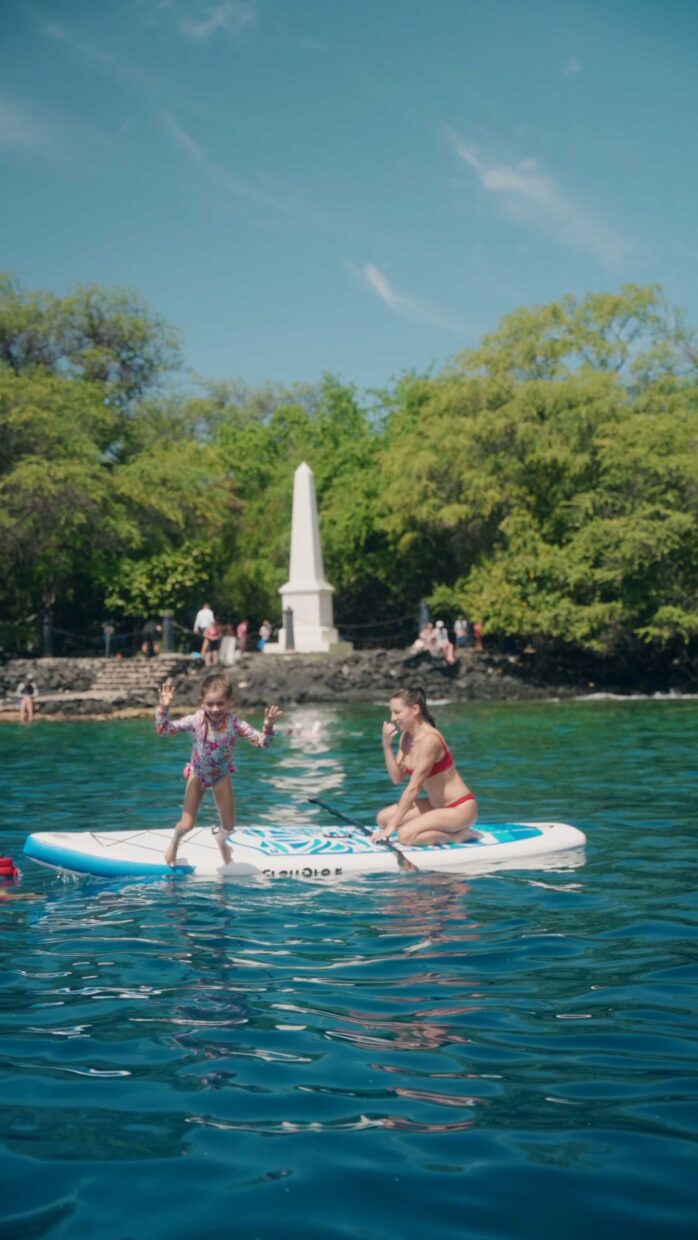
The World Famous Captain Cook Monument at Kealakekua Bay is a 27-foot-tall white obelisk built in 1874 — 95 years after Cook’s death — by a group of Cook’s fellow British countrymen who felt the site deserved formal recognition. The monument stands on the exact spot where Cook fell on February 14, 1779. The inscription reads:
“Captain James Cook, R.N., F.R.S., died on this spot, February 14th, 1779, aged 50 years. This monument was erected by his countrymen, A.D. 1874.”
The small plot of land on which the monument stands — approximately 25 square feet — is technically maintained by the United Kingdom, ceded to British custody by the Kingdom of Hawaii and later recognized by the State of Hawaii. The United Kingdom’s consul in Honolulu maintains the monument. This makes the monument one of the very few pieces of British-maintained territory in the United States.
The monument is difficult to reach. The north shore of Kealakekua Bay sits at the base of steep volcanic cliffs that rise directly from the ocean with no road or beach access. The monument can be seen clearly from the water — and the snorkeling directly below and around it is exceptional — but standing at its base requires either arriving by boat, paddling a kayak from Napo’opo’o Beach, or hiking a steep 2.5-hour trail from Highway 11.
Snorkeling Below the Monument
The waters at the base of the World Famous Captain Cook Monument at Kealakekua Bay are part of the Marine Life Conservation District, protected since 1969. This protection has allowed the reef to develop into one of the healthiest and most biodiverse snorkel environments in the State of Hawaii. Visibility frequently exceeds 60–80 feet in the clear, calm water at the monument’s base.
The coral shelf begins in just a few feet of water immediately at the shoreline, extending outward through varied depths to the deeper reef formations beyond. Guests who arrive by Sea Paradise boat have direct water access from the Hoku Nui’s two wide staircases, entering the water at the base of the cliffs directly adjacent to the monument. The snorkel area extends to both sides of the monument along the cliff face, where lava tube formations shelter octopus, moray eels, and whitetip reef sharks.
How to Reach the World Famous Captain Cook Monument at Kealakekua Bay
- By boat with Sea Paradise (recommended) — Daily morning and afternoon tours depart Keauhou Bay aboard the Hoku Nui. Breakfast and lunch on the morning tour, light snacks on the afternoon tour. All gear provided. Marine naturalist briefing on the sail. Direct water access at the monument. ~45-minute sail each way.
- By guided kayak — Kayak tours operate from Napo’opo’o Beach. The paddle is approximately 45–60 minutes each way under calm conditions. Not recommended in high surf or strong winds. Kayak rentals and tours available seasonally.
- By hiking — The Captain Cook Monument Trail begins off Highway 11 near where it intersects with Napo’opo’o Road. Look for three tall royal palm trees at the trailhead — the dirt trail descends steeply toward the bay. The hike is approximately 2.5 hours each way with significant elevation change, no shade, and no facilities. Carry ample water and return well before dark.
World Famous Captain Cook Monument at Kealakekua Bay FAQ
Captain James Cook died at Kealakekua Bay on February 14, 1779, during his third Pacific voyage. After arriving in January 1779 to a welcoming reception that coincided with the Hawaiian makahiki festival, Cook’s ships departed in early February but quickly returned due to storm damage. Tensions had escalated during the absence. On the morning of February 14, Cook attempted to take the local chief hostage to recover a stolen boat. A confrontation erupted on the beach and Cook was struck and killed, dying in the shallows. He was 50 years old. His remains were later returned to his crew and buried at sea in the bay.
In a narrow technical sense, yes. The small plot of land immediately surrounding the World Famous Captain Cook Monument at Kealakekua Bay — approximately 25 square feet — has historically been recognized as British-maintained territory, originally ceded by the Kingdom of Hawaii and later recognized by the State of Hawaii. The United Kingdom’s consul in Honolulu maintains the monument. The surrounding bay and coastline are fully within Hawaii state jurisdiction. Visitors can view the monument area from the water.
The inscription on the World Famous Captain Cook Monument at Kealakekua Bay reads: “Captain James Cook, R.N., F.R.S., died on this spot, February 14th, 1779, aged 50 years. This monument was erected by his countrymen, A.D. 1874.” The monument is a 27-foot white obelisk built 95 years after Cook’s death by a group of British nationals who felt the site merited formal recognition.
For most visitors, a boat tour with Sea Paradise is the best option. The tour provides direct water access at the base of the World Famous Captain Cook Monument at Kealakekua Bay, all snorkel gear, a marine naturalist briefing, food and beverages, and the experience of sailing the Kona Coast — without the physical demands of the 2.5-hour hike or the open-water logistics of kayaking. Sea Paradise offers morning and afternoon snorkel tours daily from Keauhou Bay pier.
Yes. The reef below the World Famous Captain Cook Monument at Kealakekua Bay sits inside the Marine Life Conservation District, protected since 1969. Snorkelers may see whitetip reef sharks sheltering in lava tube formations and an extraordinary density of tropical reef fish, including parrotfish, yellow tang, Moorish idols and humuhumunukunukuapuaa, Hawaii’s state fish. From the deck of the Hoku Nui, guests may also spot Hawaiian green sea turtles, spinner dolphins and spotted eagle rays along the coastline.