Manta Village Kona — The Complete Guide
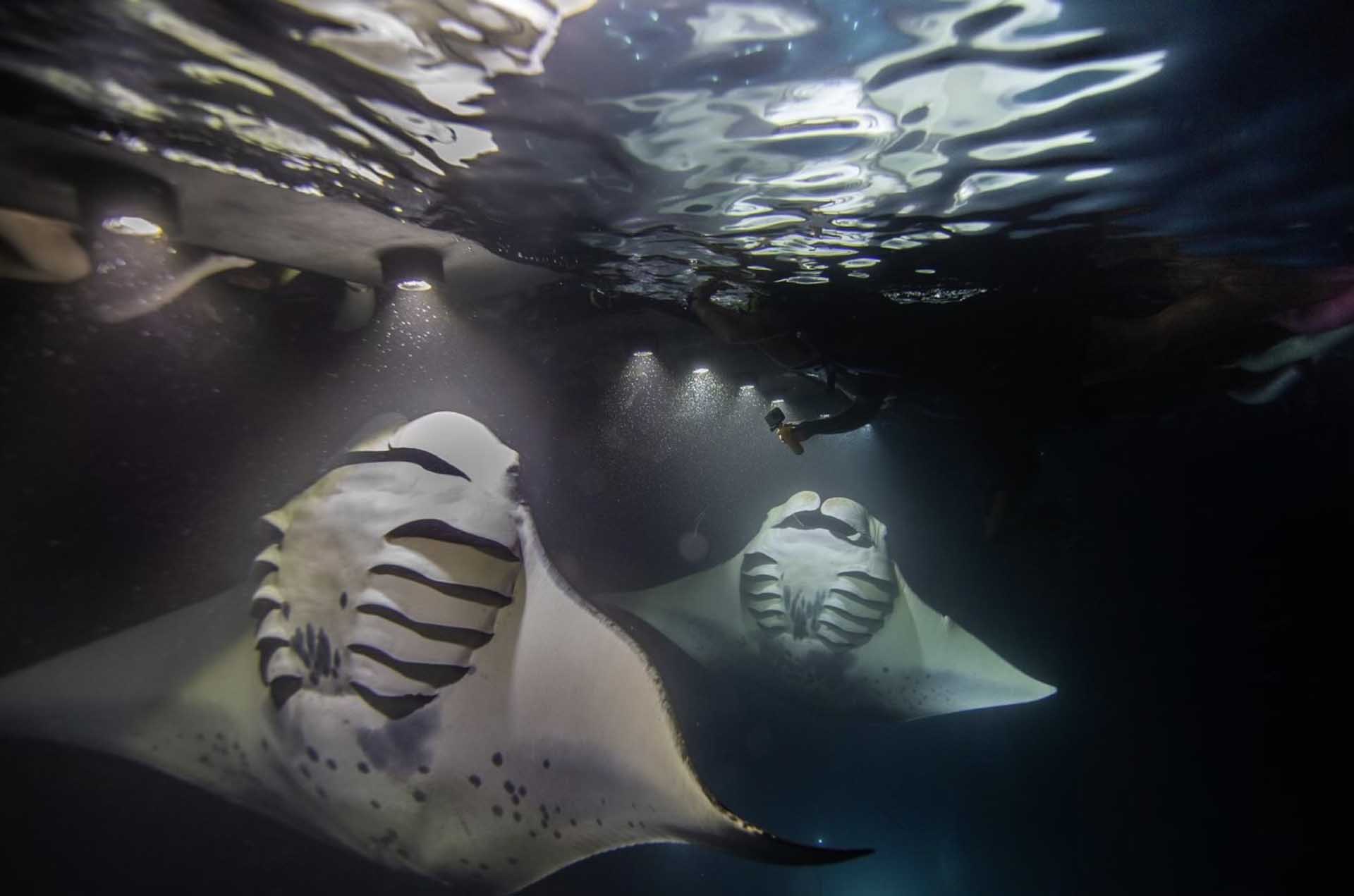
Manta Village is the most famous manta ray viewing site on the Kona Coast of Hawaii’s Big Island — a designated area near Keauhou Bay where manta rays (Mobula alfredi) gather nightly to feed, drawn by underwater lights that attract their plankton food source. Sea Paradise Hawaii has operated nightly manta tours to Manta Village since 1985, making it one of the site’s original and longest-running tour operators. Manta sighting rates at this location run 85–95%.
Quick Details — Manta Village Kona
Quick Details
How Manta Village Began
Manta Village was not planned, designed, or engineered. It happened by accident — and the story of how it began is one of the most remarkable chapters in marine wildlife history.
In the 1970s, workers constructing what is now the Outrigger Kona Resort and Spa were falling behind schedule. To speed up construction, they began working around the clock — stringing powerful floodlights along the shoreline to illuminate the work site at night. Those lights extended over the water’s edge. Plankton — microscopic organisms that drift toward light sources — congregated in the illuminated water. One night, a lone reef manta ray followed the plankton to the surface. It fed there. It returned the next night. Over time, it brought others.
What the construction crew observed accidentally, researchers later understood through the lens of Classical Conditioning — the same behavioral mechanism Pavlov demonstrated in his famous experiments. The reef manta population along the Kona Coast learned, over generations, that light sources mean food. Today that learned behavior is the foundation of one of the world’s most reliable wildlife viewing experiences.
Sea Paradise began operating organized manta tours to this site in 1985. The underwater lights deployed by tour operators replicate exactly what the construction floodlights created — an illuminated plankton concentration that brings the mantas reliably, predictably, night after night.
The Science of the Manta Village Experience
The Manta Village experience is built on a simple but extraordinary ecological feedback loop. It works like this:
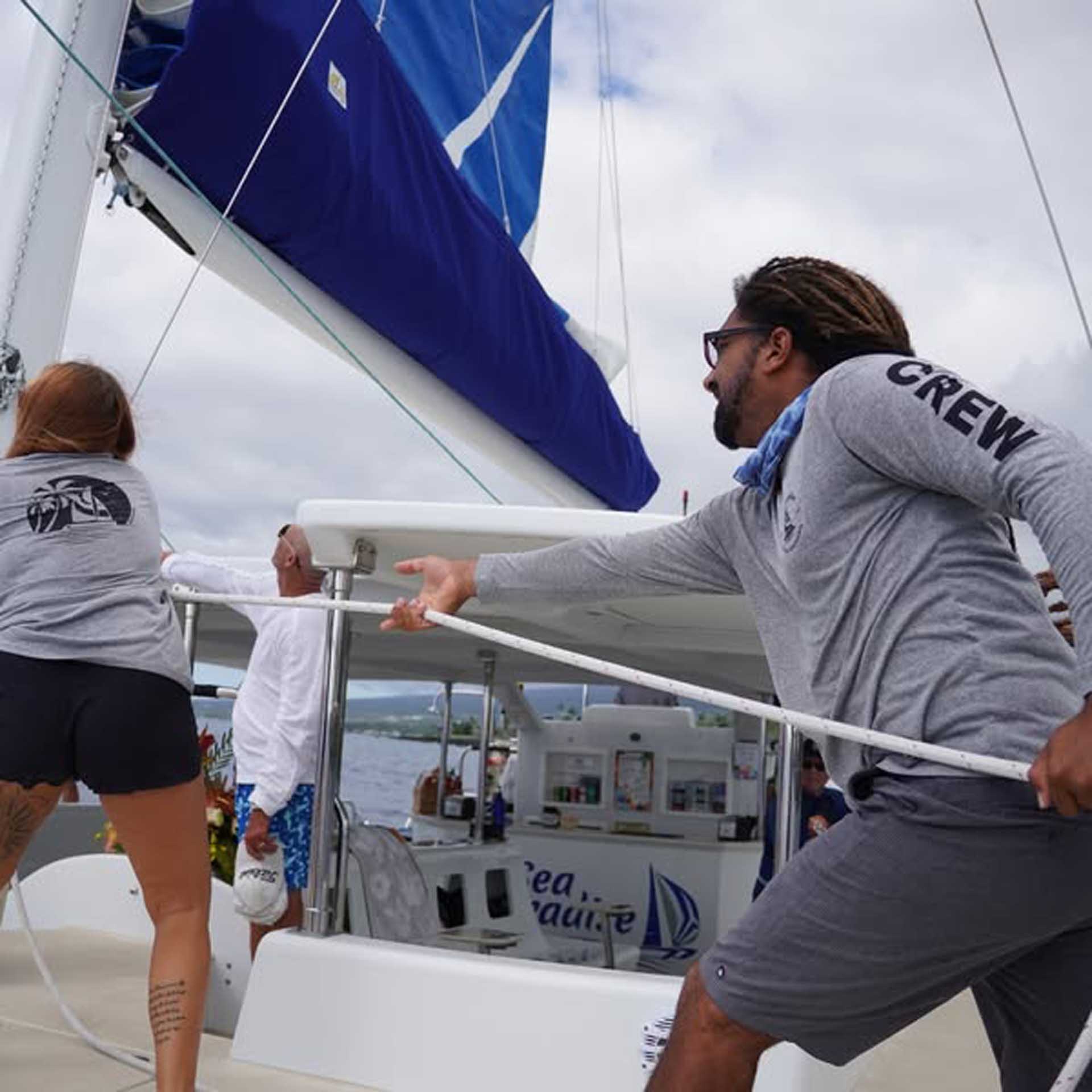
- Crew aboard the Hoku Nui anchor at the Manta Village site and deploy lights pointed downward from the surface
- The lights attract zooplankton — the microscopic crustaceans and planktonic organisms that make up the manta ray’s diet
- Manta rays that have learned the association between light and food appear at the site and begin feeding
- Mantas feed by swimming through the plankton concentration with mouths open, filtering organisms through their gill rakers
- Their characteristic feeding spirals, rolls, and somersaults are behavioral adaptations to maximize plankton intake — and incidentally create the extraordinary visual display guests observe from above
Guests float on the surface on custom Manta Flotation Devices provided by Sea Paradise, positioned above the lights, watching the mantas feed below. The role of the guest is purely passive — the mantas are not performing for an audience; they are feeding on their natural food source. Human presence is incidental to an entirely natural behavior.
Who Lives at Manta Village
The Kona Coast reef manta population numbers over 450 individually identified animals, catalogued using photo-identification by researchers at Manta Ray Advocates Hawaii and the Manta Pacific Research Foundation. Individual mantas are identified by the unique spot pattern on their white ventral surface — a pattern as distinctive as a human fingerprint that never changes over a lifetime.
The most famous Manta Village residents include Lefty, the first Kona manta ever identified (in 1979), who is recognizable by a damaged left cephalic fin and has been documented at this site for over 45 years. Big Bertha — one of the largest females in the population with an estimated 14–16 foot wingspan — has been tracked since 1991 and has been documented through multiple pregnancies. Other well-known regulars include Koie Ray (known for swimming boldly close to snorkelers), Jolene Ray (a petite 5-foot-wide female who appears reliably), Obama Ray (confirmed female, named after confirmation), Quarantina (first spotted during the COVID-19 pandemic), and Elvis.
Manta Village FAQ
Manta Village is located off the Keauhou coastline on the south Kona Coast of Hawaii’s Big Island, in the waters near the Outrigger Kona Resort and Spa. The viewing site is in open waters offshore. Sea Paradise departs to Manta Village nightly from the Keauhou Bay pier at the end of Kaleiopapa Street, Kailua-Kona, HI 96740.
Manta Village is in open ocean and can theoretically be accessed by individual swimmers or kayakers — it is not a protected exclusion zone. However, visiting independently without underwater lights drastically reduces the likelihood of encountering manta rays, as the plankton-attracting lights are the mechanism that draws them to the surface. Swimming in open ocean at night without an experienced crew and safety equipment also carries significant risk. Organized tours with Sea Paradise are strongly recommended.
Organized manta ray tours in Kona grew out of the informal observations that began in the 1970s during hotel construction. Sea Paradise has operated nightly manta tours since 1985, making it one of the original operators at this site. The research catalogue of individually identified mantas at Manta Village extends back to 1979, when Lefty was first documented.
Manta Village produces consistent sightings year-round. The resident reef manta population does not migrate — they remain along the Kona Coast in all seasons, and the Classical Conditioning feeding behavior at the site operates 365 days a year. Sighting rates are 85–95%. Ocean conditions on the sail to and from the site are slightly calmer during the summer months (May through September), which may be a consideration for guests who prefer flatter water.
Classical Conditioning — the same behavioral mechanism described by Pavlov — explains the reliability. Over generations, the reef manta population of the Kona Coast learned that artificial light sources attract zooplankton, their primary food source. When tour operators including Sea Paradise deploy underwater lights at Manta Village, the plankton concentrates and the mantas follow. This learned, inherited behavior is what produces the extraordinary nightly consistency that makes Kona’s manta encounters unique in the world.
Manta rays are wild animals and no sighting can be absolutely guaranteed. Sea Paradise offers a Manta Guarantee: return free within 7 days if no mantas seen, on a space-available basis. It is a free rebooking, not a refund. Full terms are at https://seaparadise.com/manta-guarantee/. Sighting rates run 85–95%, which is among the highest for any organized wildlife encounter in the world.