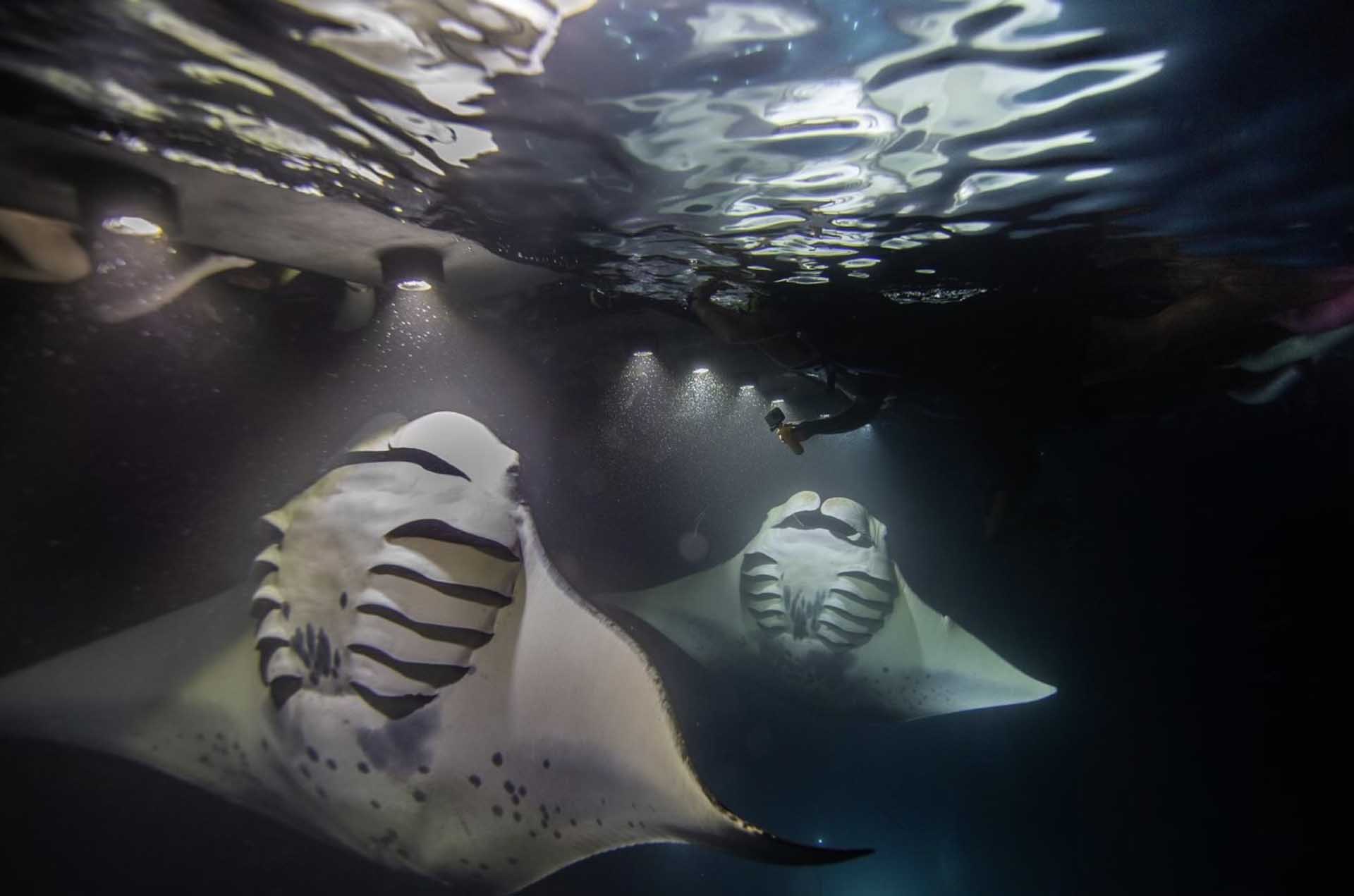
The Kona Coast is home to more than 450 individually identified reef manta rays — the largest documented resident population in the Hawaiian Islands. Researchers at Manta Ray Advocates Hawaii and the Manta Pacific Research Foundation catalog each ray using the unique spot patterns on their undersides, which function like fingerprints. Many of these rays have been given names and carry documented histories spanning decades. Sea Paradise crew members recognize dozens of individuals on sight, and guests on the manta ray night snorkel tours frequently encounter the named residents below.
The Kona Coast is home to more than 450 individually identified reef manta rays — the largest documented resident population in the Hawaiian Islands. Researchers at Manta Ray Advocates Hawaii and the Manta Pacific Research Foundation catalog each manta ray using the unique spot patterns on their undersides, which function like fingerprints. Many of these rays have been given names and carry documented histories spanning decades. Each night a select few manta rays join Sea Paradise for an intimate memorable experience. The crew members identify manta rays on sight. Guests on the manta ray night snorkel tours frequently encounter the named residents below.
First identified: 1979 | Identification: Damaged left cephalic fin | Sex: Female
First documented: 1991 | Wingspan: 14–16 feet | Sex: Female | Notable: Multiple documented pregnancies
Big Bertha is one of the most recognized manta rays in the world. First documented at Manta Village in 1991, she has been a fixture in the resident population for over 30 years. Her wingspan — estimated between 14 and 16 feet — places her among the largest reef manta rays ever measured. She has been observed through multiple pregnancies over the decades, meaning there are manta rays swimming these waters today that are her direct descendants. When Big Bertha appears, everything else goes quiet.
First identified: 2001 | Sex: Female | Known behavior: Approaches snorkelers closely
Size: Approximately 5 feet wide | Sex: Female | Known as: The smallest regular performer
Sex: Female | Originally named: Barack Obama | Renamed: Michelle Obama (also called Obama Ray)
First identified: 2020 | Season: COVID-19 lockdowns | Sex: Unknown
Wingspan: 10–11 feet | Sex: Female
Sex: Male | Known for: Resilience — identified despite multiple injuries
Sex: Female | Frequently observed by: Local divers and tour crews
Calamity Jane is a well-known female among Kona’s dive and tour community. She has been a regular at Manta Village for years and is considered one of the more reliably appearing individuals among the senior resident population.
Every manta ray on the Kona Coast carries a unique pattern of spots on its underside — no two are the same. If you photograph a manta ray during your Sea Paradise tour and cannot identify it in the existing catalog, you can submit the image to the Manta Ray Tracker database maintained by Manta Ray Advocates Hawaii. If researchers confirm it is a new individual — one that has never been cataloged before — you may be given the opportunity to name it.
The catalog grows with every season, and guests have contributed to it. Bring an underwater camera or GoPro (rentals available onboard) and you are participating in an ongoing citizen science effort that extends the knowledge base for the entire population.
The Kona Coast hosts a resident population of over 450 individually identified reef manta rays (Mobula alfredi). Researchers at Manta Ray Advocates Hawaii and the Manta Pacific Research Foundation catalog each individual using the unique spot patterns on their undersides. The catalog is maintained as a living database and grows as new individuals are documented.
Not necessarily the same individuals every night, but many named residents appear with high frequency. The site draws from a large resident population, and the feeding behavior at Manta Village is a learned, generationally reinforced pattern. Some individuals — like Koie Ray and Big Bertha — are extremely consistent visitors. Others cycle through less predictably.
Lefty was the first manta ray ever identified on the Kona Coast, documented in 1979. She is recognizable by her damaged left cephalic fin and has been observed over a period spanning more than four decades.
Research suggests manta rays may recognize individual boats and associate them with food sources, a form of behavioral conditioning consistent with their appearance at Manta Village. Whether they distinguish individual humans is not established by current research, but their comfort with regular guides and crew members suggests at minimum a tolerance of familiar activity patterns.
Re-book for FREE if you do not see a Manta Ray on your tour. (Manta Rays are a wild marine animal. Sea Paradise does not guarantee the sighting of a Manta Ray.)
Our Manta guarantee: ” If a manta ray isn’t seen the night of your trip. Return free on any regularly scheduled Manta Ray experience during the next 7 days. Space available and advanced reservation required for return trip.
*This is NOT a money back guarantee.