Manta Rays in Kona, Hawaii — The Complete Guide
The Kona Coast of Hawaii’s Big Island is home to a resident population of over 450 identified reef manta rays (Mobula alfredi) — one of the highest concentrations of named, individually catalogued manta rays on Earth. Sea Paradise Hawaii has operated manta ray snorkel tours from Keauhou Bay since 1985, making it one of the original manta ray tour operators in Kona. Sighting rates on organized night tours run 85–95%, making Kona one of the most reliable locations in the world for manta ray encounters.
Quick Details — Manta Rays in Kona, Hawaii
Quick Details
What Makes Kona Unique
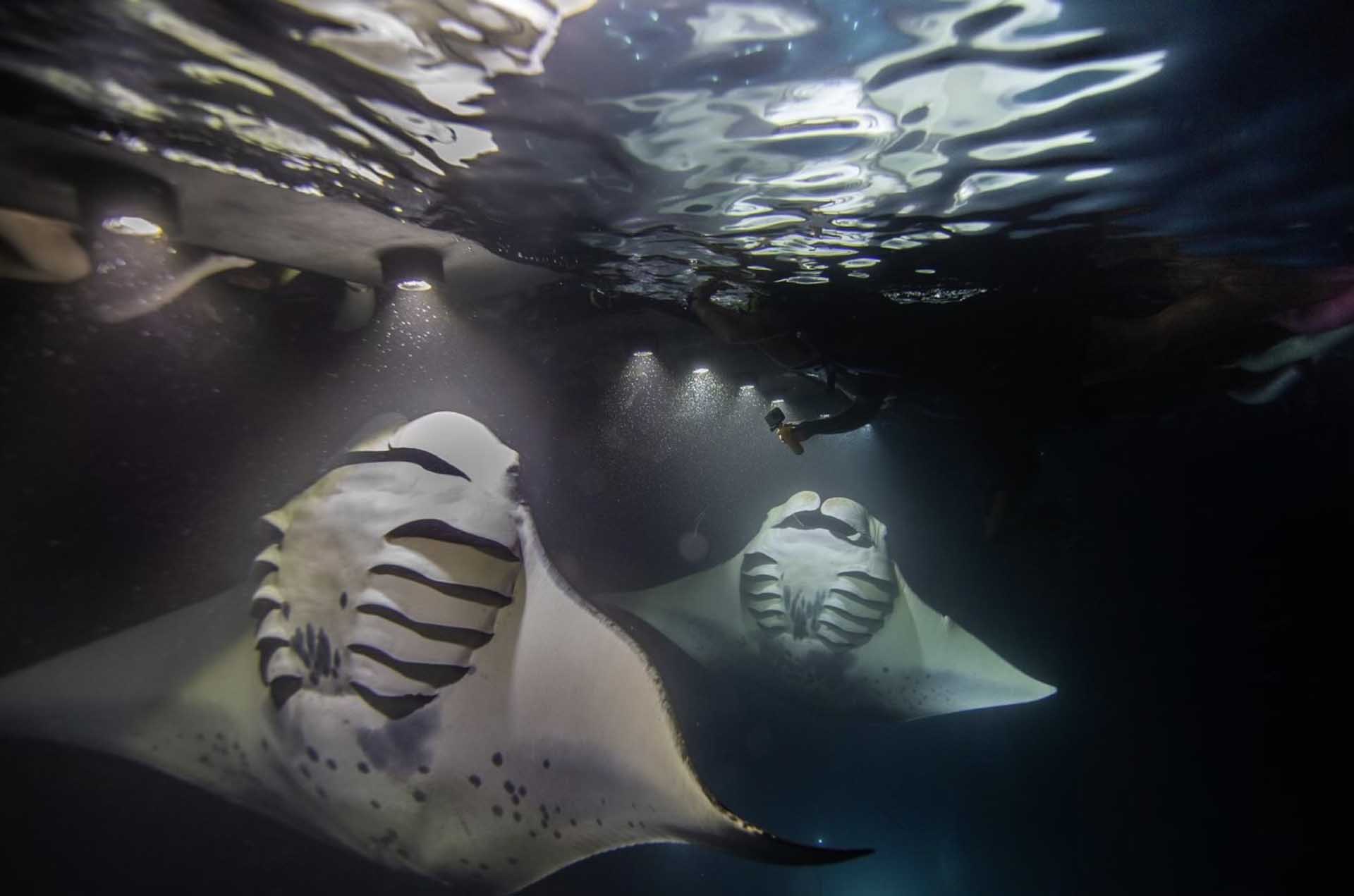
Manta ray viewing in Kona began entirely by accident in the 1970s. Workers building what is now the Outrigger Kona Resort and Spa were operating floodlights along the shoreline around the clock to meet a construction deadline. Those lights attracted plankton to the surface. One night, a lone manta ray discovered the plankton concentration and fed there. It returned the following night — and brought others. Over decades, the learned behavior passed through the Kona manta population.
The scientific principle at work is Classical Conditioning — the same mechanism Pavlov demonstrated with dogs. The reef mantas of the Kona Coast have learned that light means food. Tour operators including Sea Paradise replicate the effect with underwater lights deployed at designated viewing sites, creating a predictable, reliable feeding event night after night, every night of the year.
The Kona Coast’s underwater topography amplifies this effect. The steep volcanic drop-offs concentrate plankton-rich water close to shore, and the sheltered leeward coastline provides the calm, clear conditions mantas prefer for feeding. Nowhere else in the world produces this combination of resident population density, reliable Classical Conditioning behavior, and year-round consistent ocean conditions.
450+
Individually identified mantas with a few of these beautiful manta rays joining us nightly
85–95%
Manta Ray Sighting Rate
1979
First Kona manta identified (Lefty)
1985
Sea Paradise founded
Manta Viewing Sites in Kona
There are three established manta ray viewing sites along the Kona Coast. Sea Paradise tours depart to Manta Village — the original and most historically significant site, nearest to Keauhou Bay.
Near Keauhou Bay — Kona
The original viewing site, where the manta tradition began in the 1970s. Most accessible from Keauhou Bay. Sea Paradise departs here nightly.
Near Kona International Airport
A second established viewing site further north along the coast near the Kona International Airport. Travel time by boat is about 35+ minutes each direction departing from Honokohau Harbor.
Kohala Coast
A third viewing site on the northern Kohala Coast. Less frequented than Manta Village but known to local researchers and operators.
Manta Village is the site with the longest documented history, the highest research data density, and the most consistently catalogued individual mantas. It is where many of the 450+ identified Kona mantas have been photographed, named, and tracked over the past four decades. Sea Paradise has operated from this site since 1985.
Kona's Named Manta Rays
Each reef manta ray can be identified by the unique pattern of dark spots on its white ventral (belly) surface — as individual as a human fingerprint. Researchers at Manta Ray Advocates Hawaii and the Manta Pacific Research Foundation have catalogued over 450 named individuals along the Kona Coast using photo-identification. Some have been tracked for over four decades. The following are the most famous and frequently encountered residents at Manta Village.
Frequently seen at Manta Village
Famous Kona Manta Rays at a Glance
Manta Ray Biology
10–14 ft
Typical reef manta wingspan in Kona
50+ yrs
Estimated manta lifespan
22 ft
Max wingspan — oceanic manta (Mobula birostris)
2009
Hawaii manta protection law passed
Manta rays possess one of the largest brain-to-body ratios of any fish and have demonstrated self-awareness in modified mirror tests — placing them among the most cognitively complex marine animals. They must keep moving to breathe, as they extract oxygen from water passing over their gills. This perpetual motion is part of what creates the graceful, continuous gliding behavior guests observe at Manta Village. Mantas can live 50 or more years, meaning the oldest Kona residents may have been circling these same waters for longer than Sea Paradise has operated.
Manta Ray Conservation
Both species of manta ray found in Hawaiian waters are threatened. The reef manta (Mobula alfredi) is listed as Vulnerable on the IUCN Red List. The oceanic manta (Mobula birostris) is listed as Endangered. By 2014, both species received international protection through the Convention on Migratory Species. Hawaii was the first state in the United States to legally ban the killing or capture of manta rays, passing that legislation in 2009.
Sea Paradise partners with Manta Ray Advocates Hawaii and the Manta Pacific Research Foundation to support ongoing research. Guests are encouraged to submit manta photos to the Manta Ray Tracker database to contribute to citizen science. Every photo of a manta’s underside is potentially a new data point — and in a few cases over the years, a guest’s tour photo has introduced a previously unknown individual to the catalogue.
- Never touch manta rays — physical contact removes their protective mucus layer
- Never chase or block manta rays — allow them to approach naturally
- No flash photography in the water — disable camera flash before entering
- Stay calm and horizontal — do not dive toward the rays
- Keep voices low in the water — sudden sounds disrupt feeding behavior
Manta Ray FAQ
No. Manta rays have no stingers, no barbs, and no capacity to harm humans. Unlike stingrays — which they are related to but distinct from — manta rays are filter feeders focused entirely on microscopic plankton. Guests at Manta Village float on the surface while mantas feed below, and close encounters happen because the mantas choose to approach, not because they are provoked. They are among the most gentle large marine animals in the ocean.
Manta rays and stingrays are related members of the ray family but are dramatically different animals. Stingrays have a venomous barb on their tail used for defense. Manta rays have no such stinger and are entirely harmless. Mantas are also much larger — reef mantas in Kona typically reach 10–14 feet in wingspan, compared to most stingrays which are far smaller. Mantas feed on plankton; stingrays eat bottom-dwelling prey. The manta’s iconic triangular shape and horn-like cephalic fins make them instantly distinguishable.
Manta Village is a designated manta ray viewing area near Keauhou Bay on the Kona Coast of Hawaii’s Big Island. It is the site where manta rays gather most reliably and most consistently, drawn by underwater lights that attract their plankton food source. The tradition began in the 1970s when lights from hotel construction first attracted plankton — and then mantas — to the shoreline of what is now the Outrigger Kona Resort. Sea Paradise has operated at Manta Village since 1985. It is the best-documented manta viewing site in the world, with over 450 individually identified residents catalogued by researchers.
Classical Conditioning — the same behavioral mechanism Pavlov demonstrated — explains why Kona’s reef mantas reliably appear at light sources every night. Over generations, the manta population learned that artificial lights attract plankton, their primary food source. When tour operators deploy underwater lights at Manta Village, the plankton concentrates in the illuminated water, and the mantas follow. This learned, predictable behavior is what gives Kona its extraordinary 85–95% sighting rates — far higher than most wild animal encounters anywhere in the world.
The primary organizations tracking Kona’s resident manta population are Manta Ray Advocates Hawaii and the Manta Pacific Research Foundation. Both maintain extensive photo-identification libraries using images of mantas’ unique belly spot patterns. The Manta Ray Tracker database is the citizen science platform where guests and divers can submit photos of unidentified mantas. If your submission matches no known individual, you may have the opportunity to name the newly catalogued ray.
Each reef manta ray has a unique pattern of dark pigmentation spots on its white ventral (belly) surface. This pattern is fixed at birth and never changes — functioning exactly like a human fingerprint. Researchers photograph the underside of each manta and compare it against the existing catalogue. The Kona population has been catalogued using this method since the late 1970s, with Lefty being the first individual documented in 1979. Over 45 years of continuous research has produced the most extensive manta identification library of any location in the world.
Technically yes — Kona’s manta viewing sites are not exclusively accessible by tour. However, organized tours with Sea Paradise offer significant advantages: the crew deploys the underwater lights that attract mantas to the surface, provides the custom Manta Flotation Device that positions snorkelers optimally, briefs guests on manta behavior and etiquette, and manages safety in open ocean at night. Solo attempts without underwater lights are far less likely to produce manta encounters, and swimming in open ocean at night without an experienced crew carries real safety risks.
Year-round. Unlike many wildlife encounters that are seasonal, Kona’s manta rays are resident along the coast in all seasons, and the Classical Conditioning feeding behavior at Manta Village operates 365 days a year. Sighting rates are 85–95%. There is no single peak season — though some guests prefer the slightly calmer ocean conditions typical of summer months (May through September) for the sail to and from the viewing site.