
Here’s a good article on Manta Rays from a 2019 article by JoAnna Klein for the New York Times.
Sea Paradise Sailing and Snorkeling Tours is a great way to see these graceful creatures up front and personal.
Scientists are trying to work out why some manta rays have black blotches on their skin, which is uncommon in the oceans.
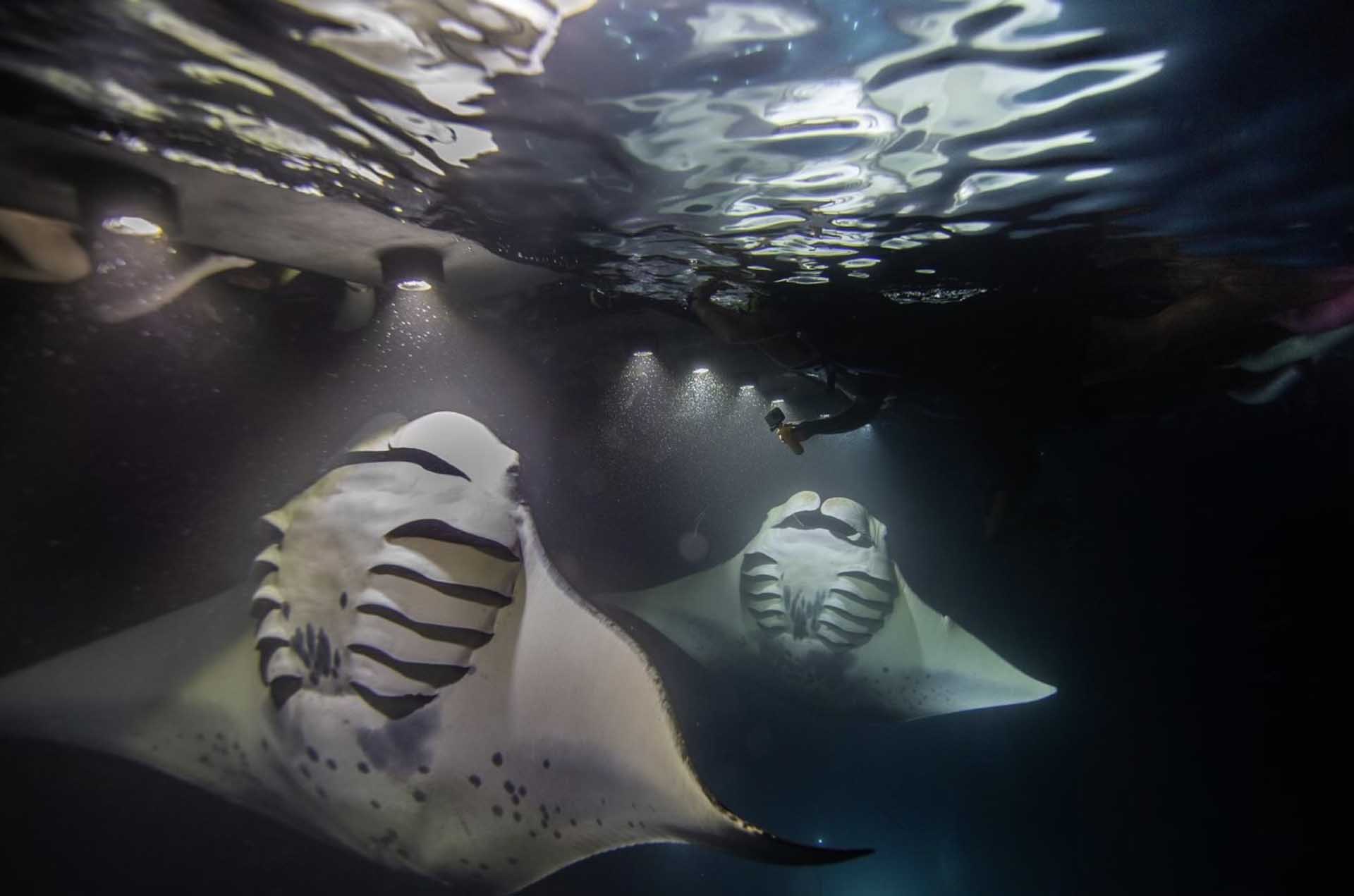
Spanning up to 25 feet from wing to wing, manta rays look like U.F.O.’s from below. If you ever get a chance to dive with them, look up. Lights won’t beam down and abduct you, but something about their bellies may surprise you. Most are white, but some are splattered with unique black blotches.
This trait, known as melanism, is seen with some frequency on land. For many terrestrial animals, having a black coat seems to offer an evolutionary advantage. It helps some pocket mice hide out, some snakes regulate their body temperature and some insects resist diseases.
But underwater, melanism is far less common. Of the hundreds of species of cartilaginous fish in the ocean, only two — the two known species of manta rays — exhibit this trait, and then only in some populations. The reason for this dark pigmentation has long been unknown.
The mystery of the melanistic mantas remains unsolved. But in a study published Tuesday in Proceedings of the Royal Society B, researchers confirmed that some manta ray populations have more melanistic individuals than others, and at least one possible explanation was definitively eliminated. For the moment, the team hypothesizes that an evolutionary process that is neutral, and not related to predation, might be at play. And their work demonstrates that some scientific questions don’t have black-or-white answers.
“There are a lot of things that we don’t understand about why animals are the way they are and how they have evolved,” said Stephanie Venables, a graduate student at the University of Western Australia and lead author of the study.
To study the manta-ray enigma, the researchers looked at the frequency of melanism in thousands of photos uploaded by divers, dive operators and underwater photographers between 2003 and 2018 in different locations in and around the Indian and Pacific oceans.
They found that melanism varied from place to place. In Indonesia’s Raja Ampat islands, for example, 40 percent of the reef manta population was melanistic, but in others, it was hard to find even two melanistic mantas. This suggested that some evolutionary advantage could be selecting for this trait in these populations, but what?
Mantas have few predators, in part because of their size. They also tend to have white bellies, which enable them to blend in with contrasting light from the surface and avoid being seen from below. Presumably a black belly would make them more conspicuous, and more prone to predation. The researchers tested that idea by following a few individual animals through years of photos, then determining whether coloration influenced the animals’ survival.
The results, described in the new paper, showed no difference in the survivorship of white and melanistic rays. Whatever the role of those dark blotches, they weren’t making the rays more visible to predators.
One potential explanation for why some manta populations may have more melanism than others, they say, is that the trait may spread at random when different groups meet. Or perhaps the trait is passed down among individuals in populations that have become isolated.
Genetics are complex, and in future research Ms. Venables and her colleagues hope to identify the genes responsible for melanism in mantas, which could be linked to other traits that are important for survival.
Dr. Venables also hopes that by expanding their investigations globally, they may gain a better understanding of how different groups of manta rays are connected. That might improve efforts to protect vulnerable populations.
“Divers and snorkelers will fly around the world to spend a bit of time with them,” she said. “But they’re also threatened, and conservation efforts are needed to make sure they’re around in the future.”