
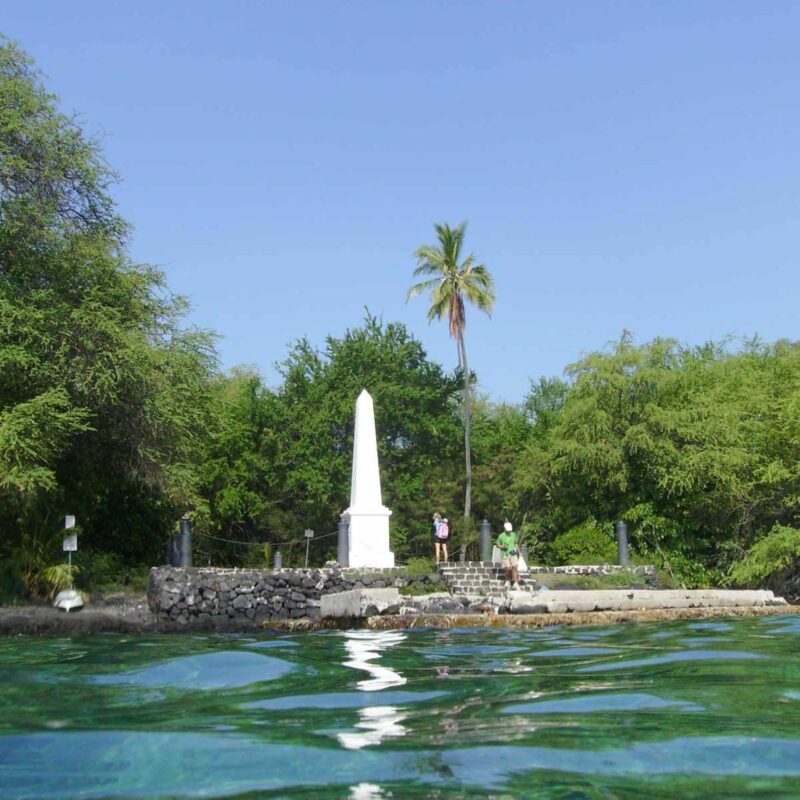
The white Captain Cook Monument on Hawaiʻi Island’s Kona Coast marks a place where Hawaiian history and European exploration intersect. Standing near the shoreline at Kaʻawaloa, the 27-foot obelisk commemorates British navigator Captain James Cook, who died at Kealakekua Bay on February 14, 1779. The monument was erected in 1874, nearly a century after his death.
But the monument tells only part of the story. Above the bay, openings in the towering volcanic cliff include ancient Hawaiian burial caves. These sacred places remind visitors that Kealakekua’s significance extends far beyond Cook’s arrival.
Kealakekua Bay Before Captain Cook
Long before European ships reached these waters, Kealakekua Bay was a Hawaiian community and ceremonial landscape. Kaʻawaloa occupied the northern shoreline, while Hikiau Heiau stood near Nāpōʻopoʻo across the bay. The remains of Kaʻawaloa’s ancient village can still be found behind the monument.
Cook participated in ceremonies at Hikiau Heiau during his January 1779 visit. Historical interpretations differ over whether Hawaiians regarded him as the god Lono or honored him as a person of exceptional rank. Presenting either interpretation as settled fact oversimplifies a complex encounter.
Understanding this Hawaiian setting changes how visitors experience the bay. The shoreline was already a place of leadership, religious practice, and community life before it became associated with a British explorer.
What Happened to Captain Cook?
Cook reached Kealakekua Bay in January 1779 after first visiting the Hawaiian Islands in 1778. His expedition initially received a generous welcome, but relations deteriorated.
Following the theft of a ship’s boat, Cook attempted to seize Kalaniʻōpuʻu, Hawaiʻi Island’s ruling chief, and hold him hostage until the boat was returned. A confrontation followed, and Cook was killed on February 14, 1779. This attempted seizure is essential context for understanding his death.
Today’s white obelisk commemorates Cook near the place where he died. It is a memorial, rather than a tomb containing his body. The Captain Cook Society describes the monument as standing a short distance from the location associated with the fatal encounter.
What Are the “Graves in the Wall”?
Visitors sometimes describe the openings above Kealakekua Bay as “graves in the wall.” More accurately, they are burial caves within the natural cliff face, known as Pali Kapu o Keōua.
Hawaiʻi’s Division of Aquatic Resources confirms that some visible lava-tube openings in the pali, or cliff, are ancient Hawaiian burial caves. Not every opening is a burial site, and they are separate from the Captain Cook Monument.
Historical research documents chiefly remains being moved from Hale o Keawe at Hōnaunau into a cave in the Kaʻawaloa cliffs around 1828–1829. Those remains were later transferred to Honolulu in 1858 and eventually placed in the Royal Mausoleum. This recorded history demonstrates the cliffs’ connection to Hawaiian chiefly burials without suggesting that every cave’s occupants are known.
These are ancestral resting places deserving reverence. Visitors should appreciate the cliffs from a distance and avoid entering caves or disturbing cultural features. Their significance lies in the people and traditions they represent.
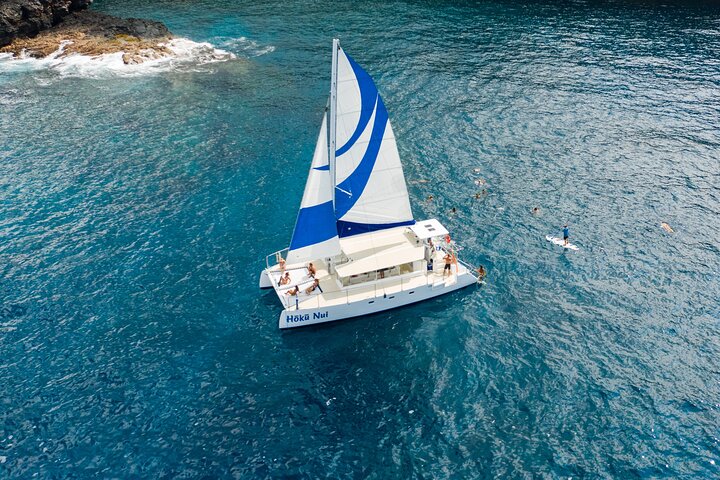
Experience the Bay Aboard Hoku Nui
A snorkeling trip offers an opportunity to appreciate both Kealakekua’s history and its underwater environment. The bay’s 315-acre Marine Life Conservation District was established in 1969, protecting a remarkable setting of coral and tropical fish.
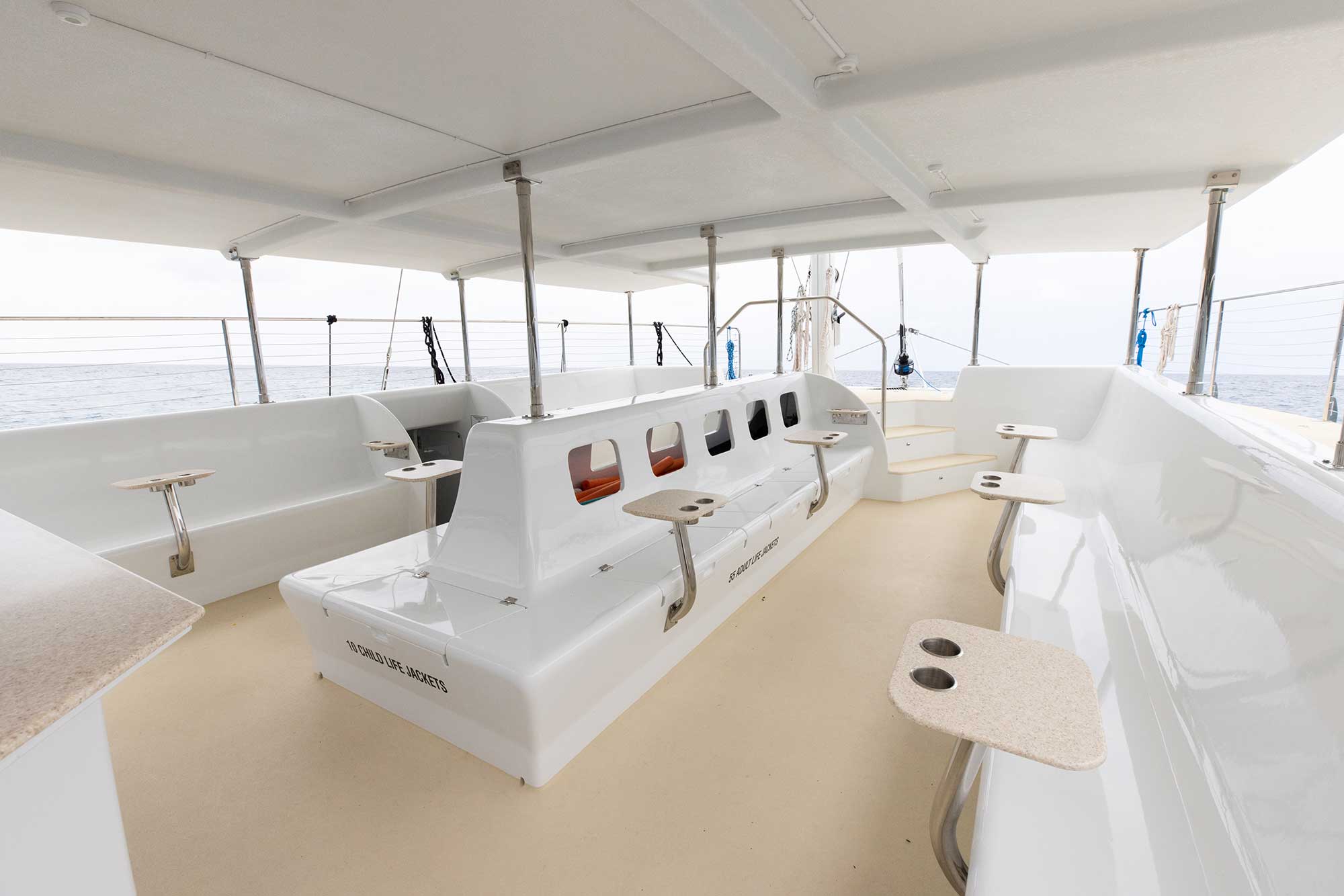
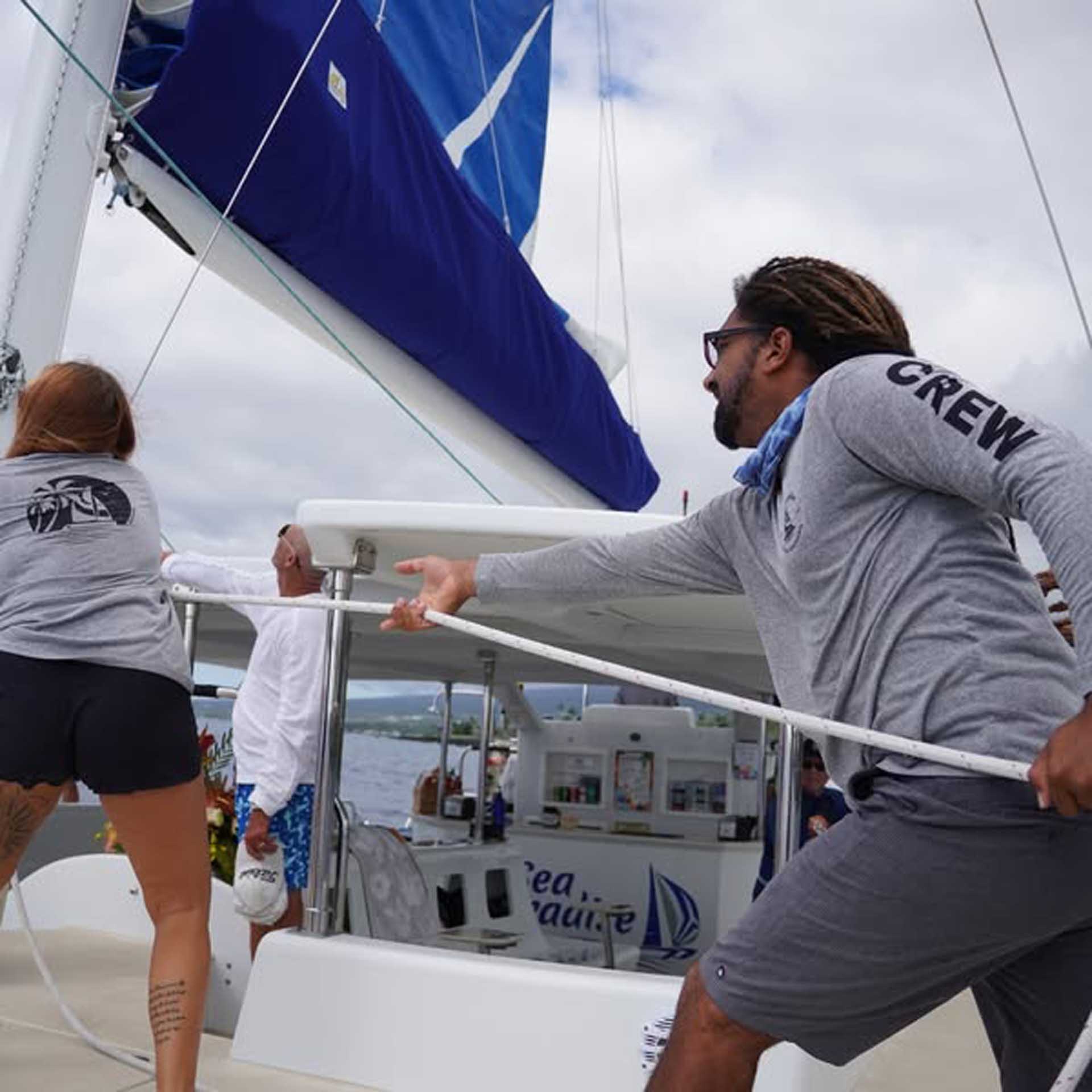
Sea Paradise Hawaii’s snorkel tours depart Keauhou Bay aboard Hoku Nui, a 50-foot luxury sailing catamaran. Its broad twin-hull design provides a stable platform, while spacious decks offer room to enjoy the Kona coastline. For travelers comparing boats, that space and stability are valuable considerations alongside smaller rigid inflatable boats.
Choose the operator carefully when comparing similar tour names, and book directly with Sea Paradise Hawaii to ensure you are reserving the Hoku Nui experience.
The most meaningful visit includes more than a photograph of the white monument. Take time to consider the Hawaiian community that lived here, the conflict that changed the bay’s history, and the ancestors honored within its cliffs.
Explore the Captain Cook Monument and plan your snorkeling experience with Sea Paradise Hawaii.