
On January 17, 1779, Captain James Cook sailed HMS Resolution and HMS Discovery into Kealakekua Bay in the middle of Makahiki, the Hawaiian season dedicated to the god Lono. Accounts of the arrival describe a crowd of about 10,000 people on shore and in canoes. Within days, priests led Cook to Hikiau Heiau, the great temple at the south end of the bay.
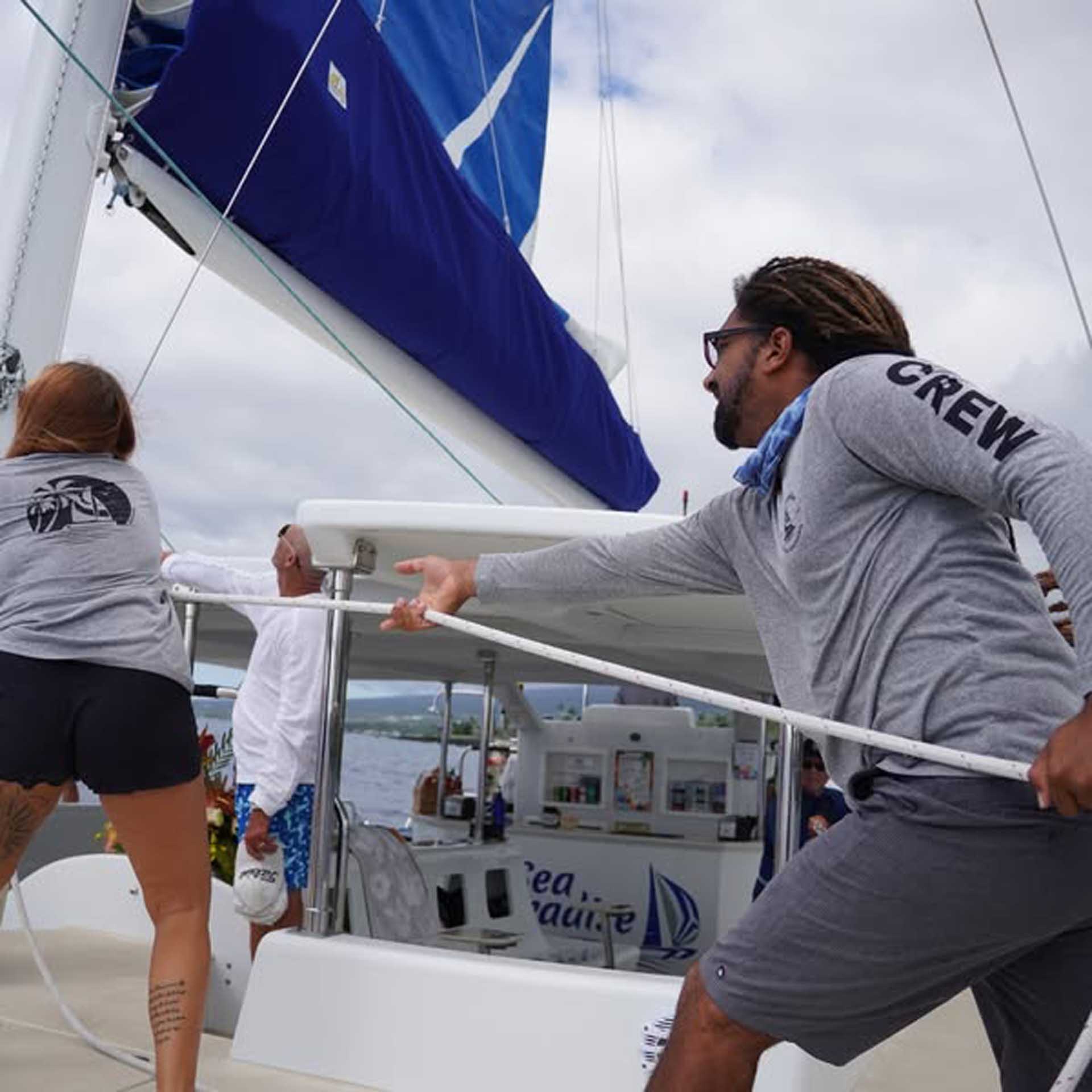
Sea Paradise Hawaii has sailed this stretch of the Kona Coast from Keauhou Bay since 1985. Here is the history behind that famous arrival, and a few details most visitors to the Big Island never hear.
What was Makahiki, and why did Cook’s timing matter?
Makahiki was the Hawaiian new-year season, a months-long period dedicated to Lono, the god of agriculture, rain and peace. Warfare was set aside, tribute was gathered district by district, and games and feasting took the place of ordinary work. Cook arrived in the middle of it, and that timing shaped everything about his welcome.
During Makahiki, an image of Lono was carried around the island in procession. Anthropologist Marshall Sahlins later pointed out that Cook had spent weeks sailing slowly around Hawaiʻi Island before he anchored, a route that echoed the god’s own circuit.
The season also had an end date. When Makahiki closed, the ritual calendar turned to Kū, the god of war. Cook’s ships left the bay on February 4, 1779, then limped back on February 11 with a damaged mast. By then, the season of peace was over.
What happened at Hikiau Heiau?
Hikiau Heiau is a luakini, a temple of the highest order, standing at the south end of Kealakekua Bay near Nāpōʻopoʻo. Cook recorded it as roughly 16 feet high, 250 feet long and 100 feet wide. Priests brought him there for an elaborate ceremony while the crowd called out the name “Lono.”
On January 26, 1779, Kalaniʻōpuʻu, the ruling chief of Hawaiʻi Island, made a formal visit and exchanged gifts. Cook’s journal says the chief placed his own feathered cloak over Cook’s shoulders, one of the highest honors a Hawaiian ruler could give.
Here is a fact few guides mention. When elderly seaman William Watman died aboard the Resolution, Kalaniʻōpuʻu asked that he be buried at Hikiau Heiau. A plaque placed nearby by the Kona Civic Club in 1928 calls his January 28, 1779 funeral “the first recorded Christian service in the Hawaiian Islands.” Hawaiian mourners added a pig, coconuts and plantains to the grave and chanted beside it for three nights.
Did Hawaiians really believe Cook was the god Lono?
Historians still disagree, and it remains one of the most famous debates in Pacific history. Marshall Sahlins argued that Hawaiians received Cook as a form of Lono. Gananath Obeyesekere answered in The Apotheosis of Captain Cook (1992) that the “white god” idea was a European myth. Sahlins replied in How “Natives” Think (1995).
What is certain is narrower. Cook was greeted with the name Lono, honored in ceremonies at Hikiau Heiau, and supplied generously while Makahiki lasted. What is also certain is how the visit ended. After a ship’s boat was taken, Cook went ashore at Kaʻawaloa on February 14, 1779 to take Kalaniʻōpuʻu hostage, and he was killed in the fight that followed.
Fact: according to accounts of the fight, the iron dagger that struck Cook had been traded from his own ships earlier in the visit.
We tell the full story of that day, and of the sacred cliffs above it, in Captain Cook Monument History: The Sacred Burial Cliffs of Kealakekua Bay
Can you still see Hikiau Heiau today?
Yes. The stone platform of Hikiau Heiau still stands beside the shoreline at Nāpōʻopoʻo, at the south end of Kealakekua Bay, with the 1928 Watman plaque nearby. It remains a sacred site, so view it respectfully: do not climb the walls or move any stones.
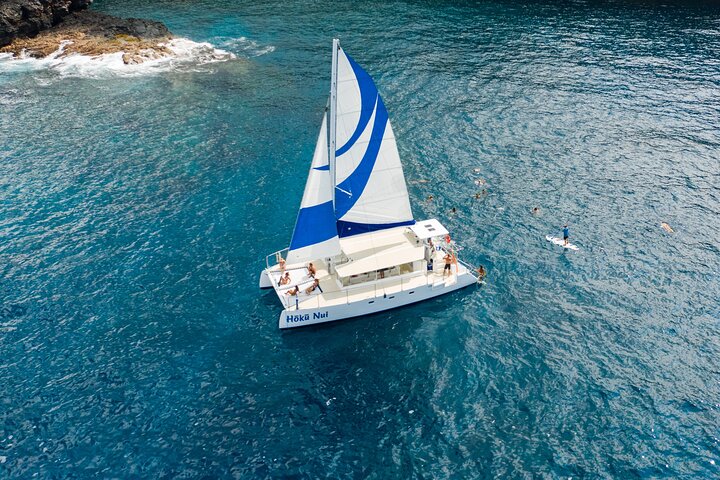
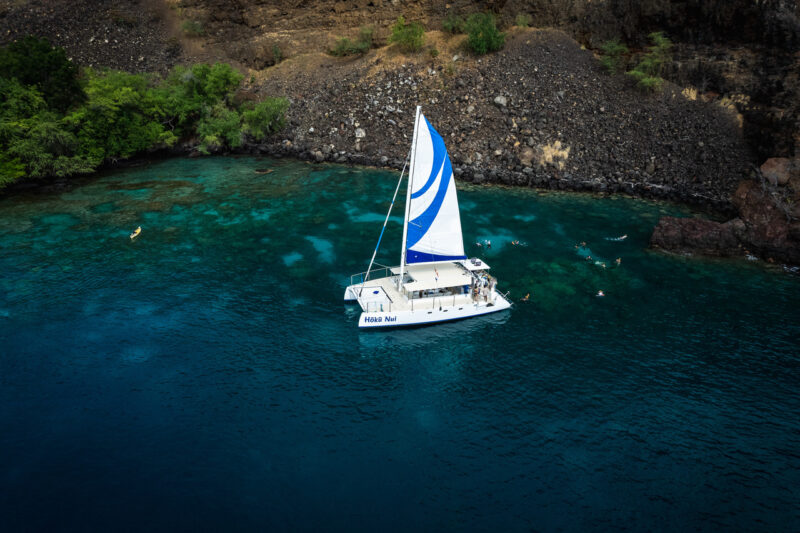
From the water, the story comes together. Sea Paradise’s Afternoon Snorkel Tour departs Keauhou Bay at 2:00 PM aboard the Hoku Nui, our 50-foot luxury sailing catamaran, and sails to the World Famous Captain Cook Monument at Kealakekua Bay, on the north shore across the bay from the heiau. In about three hours you get the history from our crew, time in the water, and an easy sail home along the Kona Coast.
For directions, protections and planning tips, read our full Kealakekua Bay guide.
Frequently Asked Questions
Why did Captain Cook stop at Kealakekua Bay?
Cook needed a sheltered anchorage to rest his crews and resupply after weeks of sailing around Hawaiʻi Island. He anchored in Kealakekua Bay on January 17, 1779, during Makahiki, the season honoring the god Lono, and was met by a crowd of about 10,000 people.
What is Hikiau Heiau?
Hikiau Heiau is a luakini, a temple of the highest rank, at the south end of Kealakekua Bay near Nāpōʻopoʻo. Captain Cook was honored there in 1779, and seaman William Watman was buried there that year in what a 1928 plaque calls the first recorded Christian service in Hawaii.
Is Hikiau Heiau where Captain Cook died?
No. Hikiau Heiau is at the south end of the bay. Cook was killed on the north shore at Kaʻawaloa, where the World Famous Captain Cook Monument at Kealakekua Bay now stands. Sea Paradise’s Afternoon Snorkel Tour sails from Keauhou Bay to the monument.