Before he united the Hawaiian Islands, Kamehameha was a young warrior in the court of his uncle Kalaniʻōpuʻu, ruler of Hawaiʻi Island. He met Captain Cook’s expedition in 1778, won his first major battle just south of Kealakekua Bay in 1782, and the sacred cliffs above the bay carry his father’s name.
Sea Paradise Hawaii has sailed this coastline from Keauhou Bay since 1985. Here is how the bay fits into the story of Hawaii’s most famous king.
Did Kamehameha meet Captain Cook?
Yes. On November 26, 1778, off the coast of Maui, Kalaniʻōpuʻu went aboard Cook’s ship. Accounts say several of his chiefs, young Kamehameha among them, stayed aboard to guide the expedition toward Hawaiʻi Island.
Weeks later, on January 17, 1779, Cook anchored in Kealakekua Bay. Kalaniʻōpuʻu made his formal visit on January 26 and placed his own feathered cloak on Cook’s shoulders. His gifts also included a feathered helmet, or mahiole.
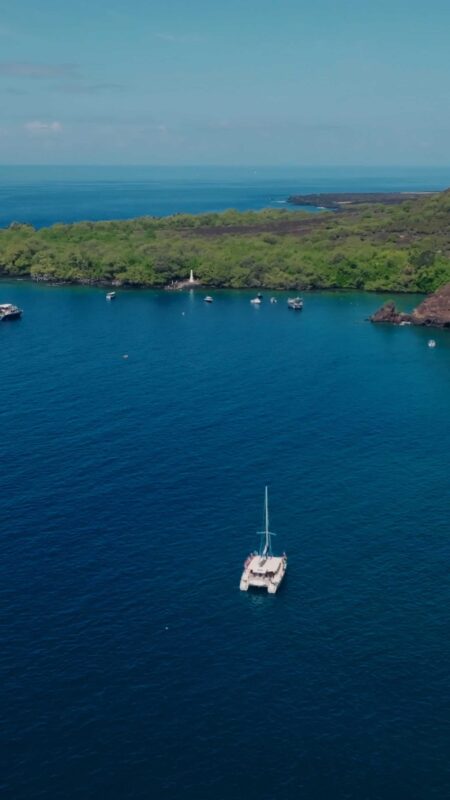
The ruling chief’s court was based at Kaʻawaloa, the village on the north shore of the bay, home to royal residences and Puhina o Lono Heiau. Today that shoreline is quiet and overgrown, and it is where the World Famous Captain Cook Monument at Kealakekua Bay now stands.
On the morning of February 14, 1779, Cook came ashore at Kaʻawaloa to take Kalaniʻōpuʻu hostage over a stolen boat. The chief’s wife, Kānekapōlei, and two chiefs pleaded with him not to go. The confrontation that followed cost Cook his life.
After Cook was killed at Kaʻawaloa on February 14, 1779, his remains were divided among chiefs. Several accounts say young Kamehameha was given Cook’s hair.
How did Kamehameha come to power after Kalaniʻōpuʻu died?
Kalaniʻōpuʻu died in Kaʻū in April 1782 and split his legacy in two. His son Kīwalaʻō inherited rule of the island and the right to distribute land. His nephew Kamehameha was given guardianship of Kūkāʻilimoku, the feathered war god.
That arrangement did not last. When the lands were divided, several powerful Kona chiefs felt cheated and turned to Kamehameha. Within months, the two sides met in battle a short distance from Kealakekua Bay.
What was the Battle of Mokuʻōhai?
The Battle of Mokuʻōhai was fought in July 1782 just south of Kealakekua Bay, near present-day Keʻei. It was Kamehameha’s first major victory. Kīwalaʻō was killed, and Kamehameha took control of Kona, Kohala and Hāmākua, the western and northern sides of the island.
Fact: estimates for Kamehameha’s army run from about 1,000 to 3,000 warriors, though historians treat early battle figures with caution.
Fact: Kīwalaʻō fell after being struck by a sling stone, a reminder of how deadly the simple sling was in Hawaiian warfare.
Fact: Kamehameha captured Kīwalaʻō’s red feather cloak in the battle, a powerful symbol of rank.
Fact: the win did not finish the job. The chief Keawemaʻuhili escaped to Hilo, and his cousin Keōua Kūʻahuʻula fled to Kaʻū. It took nine more years of war before Keōua Kūʻahuʻula died at Puʻukoholā Heiau in 1791. Kamehameha went on to unite the islands.
Fact: Kamehameha never really left this coast. He spent his final years in Kailua-Kona, a short sail north of Keauhou Bay, and died there in 1819.
Why are the cliffs above Kealakekua Bay named for Keōua?
The tall pali (cliff) above the north shore is called Ka Pali Kapu o Keōua, “the sacred cliffs of Keōua.” The name honors Keōua Nui, Kamehameha’s father, sometimes called the “father of kings” because so many rulers descended from him. Tradition holds that his remains were placed in a cave high on the cliff.
Fact: two famous Keōuas appear in this story. Keōua Nui was Kamehameha’s father; Keōua Kūʻahuʻula was the cousin who fought him. The cliffs are named for the father.
Those cliffs hold some of the most sacred burial sites on the Big Island. We tell their story in Captain Cook Monument History: The Sacred Burial Cliffs of Kealakekua Bay.
See them from the water on Sea Paradise’s Morning Snorkel Tour, departing Keauhou Bay at 8:30 AM aboard the Hoku Nui, our 50-foot luxury sailing catamaran. The tour visits the World Famous Captain Cook Monument at Kealakekua Bay, with breakfast and a deli lunch included. Our Kealakekua Bay guide has more history and planning tips.
Frequently Asked Questions
Did King Kamehameha ever meet Captain Cook?
Yes. Off Maui in November 1778, young Kamehameha was among the chiefs of Kalaniʻōpuʻu who went aboard Cook’s ship. Several accounts say that after Cook was killed at Kealakekua Bay in February 1779, Kamehameha was given Cook’s hair.
What battle happened near Kealakekua Bay?
The Battle of Mokuʻōhai, fought in July 1782 just south of Kealakekua Bay near Keʻei. Kamehameha defeated and killed Kīwalaʻō, the heir of Kalaniʻōpuʻu, and took control of the western and northern sides of Hawaiʻi Island.
Who are the cliffs at Kealakekua Bay named after?
Ka Pali Kapu o Keōua, “the sacred cliffs of Keōua,” are named for Keōua Nui, the father of Kamehameha I. Tradition holds his remains were placed in a cave high on the cliff above the north shore of the bay.
Frequently Asked Questions
Where was King Kamehameha III born?
At Keauhou Bay in Kailua-Kona on the Big Island. His official birthday is March 17, 1814. The birthplace, including the stone where legend says he was revived, has been on the National Register of Historic Places since 1978.
What is the hōlua slide at Keauhou?
It is an ancient stone sled run built for heʻe hōlua, a racing sport reserved for chiefs. About 1,300 feet survives, ending at Kaleiopapa Street, and archaeologists estimate it once ran about 4,000 feet toward the shore. It is a National Historic Landmark.
What happened at the Battle of Kuamoʻo?
In December 1819, just south of Keauhou Bay, the chief Kekuaokalani fought to restore the kapu system that Kamehameha II had ended. Kekuaokalani and his wife Manono were killed along with more than 300 warriors, and the old kapu was not restored.